
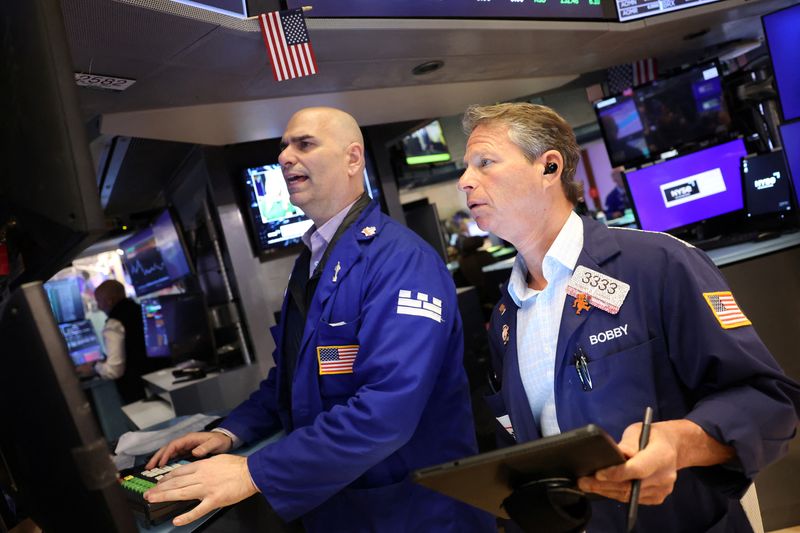
Futures tied to the largest U.S. stock indices point broadly higher. A major -- and possibly contentious -- Federal Reserve interest rate decision on Wednesday looms large, while traders are pouring through the details of a new twist in the potential acquisition of sections, or even all of, Warner Bros Discovery. Elsewhere, the White House says it will let Nvidia begin shipping its second-most advanced H200 processors to China, and Bitcoin edges lower.
1. Futures inch up
U.S. stock futures were hovering just above the flatline on Tuesday, as investors geared up for a much-anticipated Federal Reserve interest rate decision later in the week.
By 02:55 ET (07:55 GMT), the Dow futures contract had risen by 26 points, or 0.1%, S&P 500 futures had risen by 8 points, or 0.1%, and Nasdaq 100 futures had gained 26 points, or 0.1%.
The main averages on Wall Street ended lower in the prior session, weighed down by a climb in Treasury yields, in a sign that caution may be prevailing ahead of the Fed’s upcoming announcement on Wednesday (more below).
Benchmark 10-year Treasury yields, which tend to move inversely to prices, also gained upward impetus from a powerful earthquake which struck off the coast of Japan.
Beyond the Fed and bonds, traders were preparing for the release of earnings reports from tech giants Oracle and Broadcom this week, which come as markets have fretted over massive, and often debt-driven, spending on artificial intelligence.
In individual stocks, shares of Confluent jumped after IBM said it would buy the data-infrastructure firm, while a bearish outlook from Morgan Stanley sent Tesla’s stock price down by 3%.
2. Paramount’s hostile bid for Warner Bros Discovery
The battle in Hollywood to acquire Warner Bros Discovery and potentially reshape the media landscape in the process has taken another turn.
Just days after streaming titan Netflix was named the winner of a bidding war for the studio behind hits like "The Godfather," Paramount Skydance said it had launched a hostile bid worth $108.4 billion.
The amount would surpass the $72 billion equity deal Netflix had secure for Warner’s television, film studios and streaming assets -- and represent a 139% premium over the company’s value from before the buyout negotiations began. Notably, Paramount’s rival bid would be for all of Warner, including its cable television properties.
Warner’s board of directors said on Monday that it would review Paramount’s offer, although it did not change its position on the Netflix transaction and told the company not to take any action on the rival proposal.
3. Trump allows Nvidia to export H200 chips to China
Nvidia will now be allowed by the U.S. to export its H200 AI chips to China, while Washington will rake in a 25% fee on these sales, President Donald Trump has said.
It marks a modest departure from some export restrictions the U.S. had placed on sending cutting-edge AI processors to China. Previously, the most advanced semiconductor Nvidia was able to ship to the country was its prior-generation H20 model, reflecting long-time concern among some U.S. lawmakers around advances in China’s military and industrial capabilities.
The H200 stands to be around six times more powerful than the H20, according to Reuters, citing research from the non-partisan Institute for Progress think tank.
Still, given Beijing’s recent crackdown on domestic companies using U.S. technology, it is not yet clear if the White House’s new policy will boost sales for Nvidia.
Shares of Nvidia, a darling of the AI boom, ticked higher in extended hours U.S. trading, adding to a 1.7% rise in the stock on Monday.
4. Fed to begin two-day meeting
Attention is beginning to shift to the start of the Fed’s latest two-day policy meeting, which investors are expecting will end on Wednesday with a cut to U.S. interest rates.
Bets on a 25-basis point reduction by the U.S. central bank have increased following a slate of relatively tepid economic data which underlined pressure on the American job market, a marginal increase in consumer spending and stable -- albeit elevated -- inflation.
The chances of such a drawdown now stand at roughly 89%, CME FedWatch has shown. The Fed’s current target rate is now at 3.75% to 4%.
Still, there is an outside chance that officials choose to leave rates unchanged at that level, with some policymakers recently flagging concerns around unveiling a third cut since September during a time when fresh economic data has been scarce because of a record-long government shutdown.
Analysts have suggested that the decision may prove to be one of the most contentious in years.
5. Bitcoin edges lower
Bitcoin was showing signs of consolidation, with traders refraining from taking fresh positions ahead of the Fed gathering.
Lower interest rates typically weaken the U.S. dollar and reduce returns on cash and fixed-income assets, possibly making alternative, non-yielding assets like Bitcoin more attractive.
Amid these expectations of a prolonged cutting cycle, the world’s most popular cryptocurrency has had a rollercoaster 2025, notching fresh all-time peaks and sliding lower as debate over rates, tariffs, and AI rocked stock markets.
This has in turn underpinned a growing sense that a correlation between Bitcoin and risk-assets like stocks has strengthened.


 한국어
한국어
 Tiếng Việt
 中文
中文