
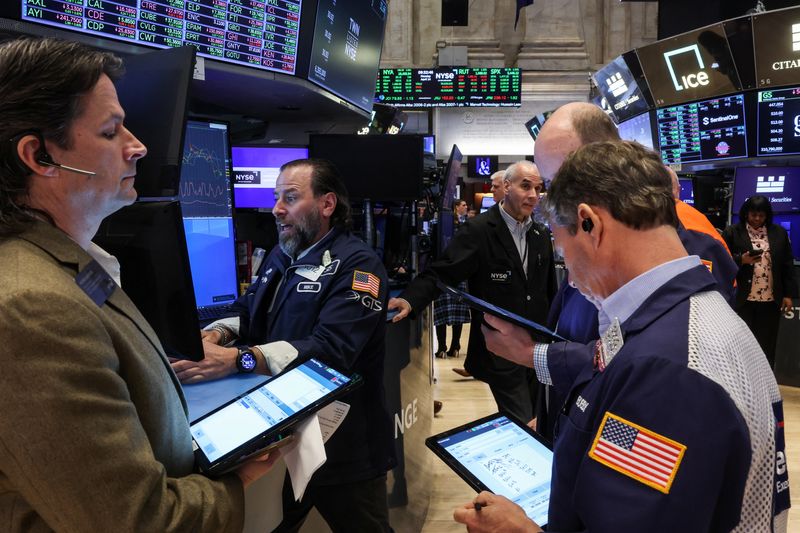
U.S. stock index futures traded either side of the flatline Tuesday, as investors awaited a key Federal Reserve decision and heavyweight technology earnings.
At 05:45 ET (10:45 GMT), Dow Jones Futures traded 40 points, or 0.1% lower, while S&P 500 Futures gained 20 points, or 0.3% and Nasdaq 100 Futures rose 155 points, or 0.6%.
The main averages advanced in the prior session, with the benchmark S&P 500 and tech-heavy NASDAQ Composite both rising for a fourth straight session. Both indices touched their highest levels in over a week, and are now on their longest streak of positive sessions since December.
Fed starts policy-setting meeting
Markets are largely in a wait-and-see mode ahead of the Federal Reserve’s two-day policy meeting, which concludes on Wednesday.
This caution means that President Donald Trump’s announcement that he is raising tariffs on South Korean imports to 25% from 15%, accusing Seoul’s legislature of failing to approve a bilateral trade deal reached last year, has had little impact on sentiment.
The U.S. central bank is widely expected to leave interest rates unchanged, with policymakers seen assessing the impact of easing financial conditions, cooling inflation trends, and a labor market that has shown signs of gradual moderation.
Recent data has reinforced expectations that the Fed will avoid signaling near-term cuts, as officials seek greater confidence that inflation will move sustainably toward their 2% target.
Aside for clues about clues on the timing and pace of potential rate cuts later in the year, investors will also be looking for any updates about the identity of the next Fed governor, with Jerome Powell’s tenure set to end in May.
"Rick Rieder’s odds of replacing Powell have shot higher in recent days following some flattering press reports," said analysts at Vital Knowledge, in a note. "
Rieder is currently a senior manager at BlackRock.
That said, "regardless of who gets the nod, Fed independence will remain under threat for at least the balance of the Trump 2.0 administration as the central bank is set to continue acting as a financial scapegoat)," Vital Knowledge added.
Earnings deluge starts
Away from the Fed, attention is also firmly on the upcoming earnings season, with more than 90 S&P 500 companies slated to report.
Earnings this quarter have been strong so far, with about three out of four S&P 500 companies beating expectations, according to data from FactSet.
While results from tech giants Meta Platforms (NASDAQ:META), Tesla (NASDAQ:TSLA), Microsoft (NASDAQ:MSFT), and Apple (NASDAQ:AAPL) will likely grab the week’s headlines, Tuesday will still see some key reports before U.S. stock markets open.
Healthcare giant Unitedhealth (NYSE:UNH), aerospace firm Rtx Corp (NYSE:RTX), and planemaker Boeing (NYSE:BA) are scheduled to announce quarterly earnings before the opening bell, as well as carmaker General Motors (NYSE:GM) and shipping player United Parcel Service (NYSE:UPS).
Elsewhere, shares of several large health insurers, including Humana (NYSE:HUM) and CVS Health (NYSE:CVS), dropped sharply premarket following a proposal by the Trump administration to set near-flat payment rates for Medicare Advantage plans, disappointing markets that had expected a more generous increase.
Gold and crude rise
Gold prices rose on Tuesday after hitting a series of record highs on concerns over Trump’s trade policies and heightened global geopolitical tensions.
Anticipation ahead of the Fed meeting this week also kept markets broadly risk averse.
Spot gold last jumped 1.6% to $5,087.54 an ounce, while gold futures for April delivery fell 0.1% to $5,120.91/oz. Spot gold hit an all-time peak of $5,111.11/oz on Monday.
Oil prices also gained, helped by supply disruptions from extreme winter conditions in the U.S.
Brent futures gained 0.5% to $65.07 a barrel and U.S. West Texas Intermediate crude futures rose 0.6% to $61.01 a barrel.
A severe winter storm has swept across the U.S., straining energy infrastructure and power grids.
U.S. oil producers are estimated to have lost up to 2 million barrels per day or roughly 15% of national production over the weekend.


 한국어
한국어
 Tiếng Việt
 中文
中文