
By Jonathan Cable
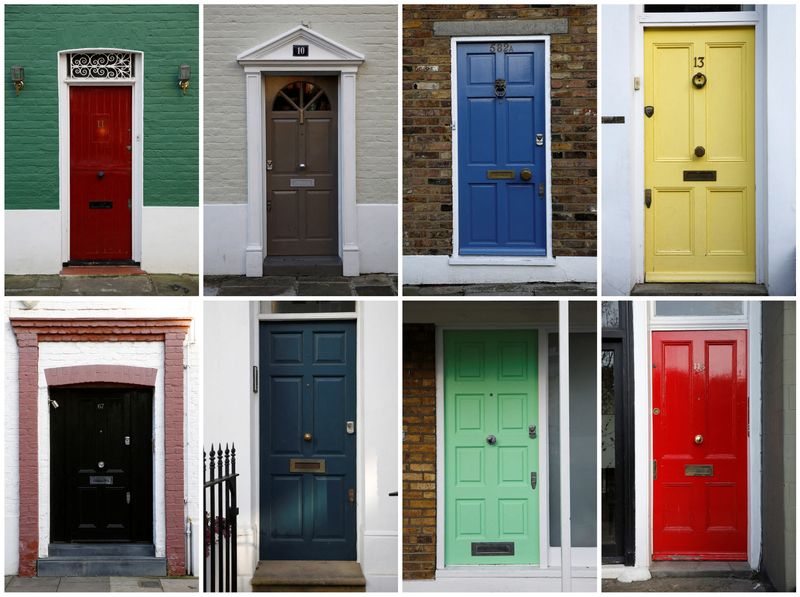
LONDON (Reuters) - British home prices will fall 4% this year, more than was thought a few months ago, as high interest rates and living costs keep potential buyers out of the property market despite a shortage of supply, a Reuters poll showed.
Average prices soared over 20% during the COVID pandemic as buyers took advantage of record-low interest rates and sought more living space, and from peak to trough are only expected to drop around 5%.
But, with inflation running at several multiples above its target, the Bank of England (BoE) embarked on an aggressive policy tightening road and has added 515 basis points to borrowing costs from just 0.10% in less than two years, making it much more expensive to pay off a mortgage.
Average home prices were predicted to fall 4% in total in calendar 2023, slightly more than a 3% drop predicted in a poll published in June but not as bad as some had expected earlier, the Aug. 14-30 poll of 18 market specialists showed.
The most pessimistic forecast was for a 10% fall, despite consumer prices expected to rise 7.5% this year, according to a separate Reuters poll.
They were expected to flatline in 2024 and rise a little over 3% the year after, little changed from the previous poll.
"Forward-looking indicators are continuing to show a decline in buyer demand and negative price expectations. This is largely the result of higher mortgage costs negatively impacting affordability and placing downward pressure on house prices," said Michael McGill at real estate firm CBRE.
"We expect prices to recover from 2024, underpinned by an improving economic backdrop."
There was evidence of a housing market slowdown in BoE data published on Wednesday as mortgage approvals by banks and building societies in July dropped more than expected, while property website Zoopla said the number of house purchases this year was on course to drop 21% to its lowest since 2012.
In London, where homes are usually far more expensive, prices were expected to fall 5% this year but increase more than nationally in the following two years with rises of 2% and 5% pencilled in.
However, there is a huge divergence between London boroughs.
"The London housing market ebbs and flows, yet is there really such a thing as a 'London property market' nowadays?" asked property consultant Russell Quirk.
"Can we truly categorise what happens in Kensington and Mayfair with oodles of foreign buyers hunting trophy homes, alongside the blue collar demographic of Barking and Dagenham?"
While the average asking price for a home in the capital was 672,961 pounds ($853,314) in August, according to property website Rightmove (OTC:RTMVY), a buyer in Kensington would expect to pay on average 1,667,486 pounds yet in Barking and Dagenham it was 367,526 pounds.
RENTAL STRESS
Those unable or unwilling to make it onto the property ladder will feel the pinch from surging rental costs.
When asked what would happen to average rents for the rest of the year all 13 respondents to an additional question said they would rise, including nine saying they would do so significantly.
So unsurprisingly 12 of 14 participants said rental affordablility would worsen over the coming year.
"The build-up of a long-term supply issue combined with soaring landlord costs are set to continue pushing up rents for the foreseeable future," said Aneisha Beveridge at estate agency Hamptons.
Private rental prices paid by tenants in Britain rose 5.3% in the 12 months to July, according to the Office for National Statistics.
($1 = 0.7886 pounds)
(For other stories from the Reuters quarterly housing market polls:)
By David Lawder
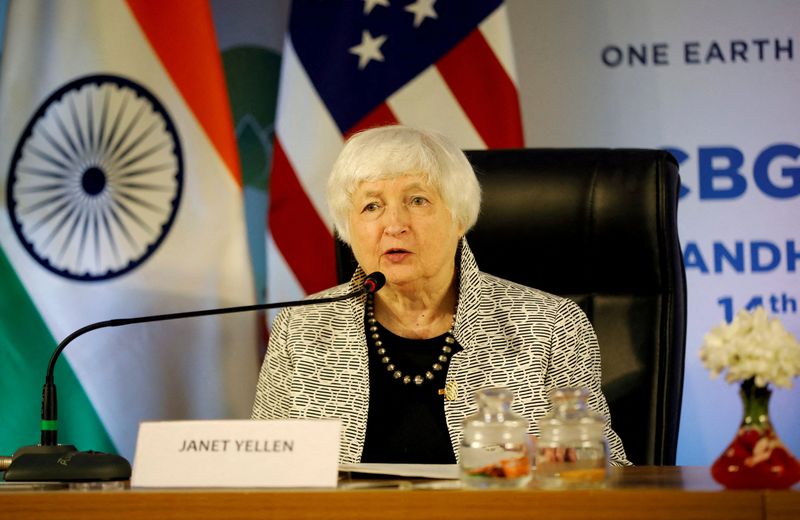
WASHINGTON (Reuters) - U.S. Treasury Secretary Janet Yellen will travel to New Delhi to participate in the G20 leaders summit from Sept. 7-10, making her fourth visit to India in 10 months, the Treasury Department said on Thursday.
Yellen intends to focus at the summit on strengthening the global economy and supporting low- and middle-income countries by advancing efforts on debt restructurings, the evolution of multilateral development banks (MDBs) and building International Monetary Fund trust fund resources, the Treasury said.
She will "continue to build momentum" for her drive to evolve the World Bank and other multilateral lenders to boost financing capacity to aid developing countries' clean energy transitions, tackle pandemics, fragility and conflict, it said.
The Treasury estimates that the lenders collectively can unlock $200 billion in new financing over a decade with balance sheet measures now being implemented or under discussion.
The Treasury said Yellen also will rally America's G20 allies to maintain economic support for Ukraine and increase costs on Russia over Moscow's continuing war in Ukraine. This includes supporting the G7-led price cap on Russian oil exports and efforts to strengthen global food security in the face of restrictions on Ukrainian grain exports.
At the same time, the Treasury said Yellen will work to deepen U.S. bilateral ties with India, a country she first described last November as a prime "friend-shoring" destination and alternative to China for U.S. investment and supply chains.
Treasury's statement did not mention specific bilateral meetings.
On the sidelines of last year's G20 Summit in Indonesia, Yellen met with the People's Bank of China's then-governor Yi Gang in first of several face-to-face meetings with senior Chinese officials in recent months to ease rocky U.S.-China ties, culminating in her visit to Beijing in July.

By Jihoon Lee
SEOUL (Reuters) - South Korea's factory activity weakened at a faster pace in August, extending its longest-ever slump by another month as export orders fell again, a private business survey showed on Friday.
The purchasing managers index (PMI) for South Korean manufacturers, compiled by S&P Global, stood at 48.9 in August on a seasonally adjusted basis, down from a 12-month high of 49.4 in July.
The sub-50 reading meant activity contracted for the 14th straight month, the longest downturn in the survey's history stretching back to April 2004.
Sub-indexes showed new export orders swung back to contraction, after their first increase in 17 months in July, keeping overall orders and output in contractionary territory for 14 months and 16 months, respectively.
In August, worries intensified over slowing economic growth in China, which had already been dragging down South Korea's exports amid weak demand.
"August PMI data signalled that South Korea's manufacturing sector saw a sustained deterioration in operating conditions," said Trevor Balchin, Economics Director at S&P Global Market Intelligence.
"The current downturns in output and new work are the longest in the survey history, although much less severe than those registered during the pandemic and global financial crisis."
On the inflation front, input prices rose again, after falling in July for the first time in more than three years. Still, output prices extended decline to a fourth straight month due to competitive pressures and client negotiations.
Suppliers' delivery times worsened for the first time in five months, as firms reported shipping delays and shortages of semiconductors in particular.
Still, stocks of finished goods fell at the fastest rate since December 2021, while backlogs of work declined at the slowest in nine months.
A measure of manufacturers' optimism for future output climbed to the highest level since June 2022, signalling some hope of a recovery in demand.

LIMA (Reuters) -Peruvian miner Minsur has announced an investment of at least $2 billion in five years as it expands its copper and tin operations, an executive told Reuters on Thursday.
Minsur is set to invest around $543 million in an underground project in Justa mine, which is owned by the firm and Chilean mining company Copec, Minsur corporate affairs executive Gonzalo Quijandria said in a phone interview with Reuters.
Another $381 million will be invested to expand the processing plant and to improve the Justa mine camp, which began operations in 2021, Quijandria said.
The mine produced 126,036 fine metric tons of copper last year and was the world's seventh most productive copper mine, according to official data.
Peru is the world's No. 2 copper producer.
Minsur also operates the only mine in Peru for tin, a relatively rare element, and produces about 9% of this metal globally, according to the company.
Regarding such a production, Quijandria said Minsur plans to invest $462 million in its tin production line and another $100 million in tin exploration projects in the country.
"They are sustaining investments that include new tailings dams in the San Rafael mine and improvements in the Pisco smelter," he said.
Minsur also plans to invest some $342 million in the modernization of its polymetallic producer Minera Raura.
Earlier on Thursday, Peru's ministry provided a different breakdown of figures from the company, and Reuters did not receive an immediate response to a query about the discrepancy.
The announcement followed a meeting between Minsur CEO Juan Luis Kruger and Peru's energy and mines minister, Oscar Vera.
The Mina Justa Subterranea project will be the second largest and most modern underground mine in Peru," the ministry said in a statement, adding that Minsur expects to present the first permits for the project in the first months of next year, with production expected to start in 2027.
By Timothy Aeppel
(Reuters) - Even a robot invasion can't beat a slowing economy.
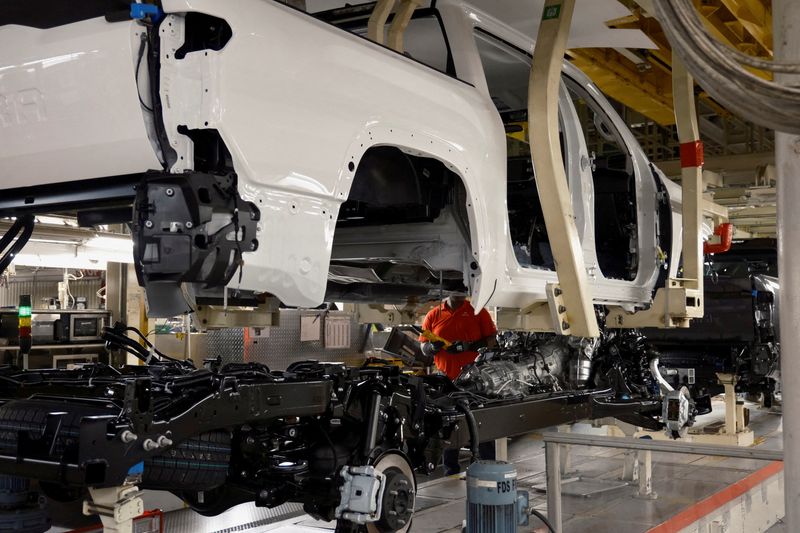
Companies in North America sharply cut orders for the high-tech machines in the second quarter, according to data compiled by the Association for Advancing Automation, an industry group.
The slowdown in orders began at the end of last year, as rising interest rates and sagging economic growth curbed appetites for new robots, the group, also known as A3, said.
"We wouldn't even consider buying a robot right now," said Nancy Kleitsch, chief financial officer of ICON Injection Molding, a maker of plastic components in Phoenix.
Like many producers, ICON's business shot up during the COVID-19 pandemic, including demand for its plastic tubes used in pandemic testing. But demand for the tubes and other parts of the company's business have now slumped to levels not seen in at least seven years, Kleitsch said.
INFLATION, GROWTH WORRIES
Many other companies appear to share ICON's hesitation on robots. Factories and other industrial users, including e-commerce warehouses and medical testing companies, ordered 7,697 robots in the second quarter, a 37% decline from a year ago. That followed a 21% drop in the first quarter and 22% decline in the fourth quarter of last year.
Robot sales boomed through the pandemic, as producers scrambled to use the machines to churn out badly needed goods. Indeed, even with the slowdown that hit late last year, 2022 marked a record year for orders, according to A3.
But robots are just one type of equipment companies need, and other gauges of spending have held up somewhat better in the U.S. economy. Orders for non-defense capital goods excluding aircraft - closely watched by economists to track trends in business spending - rose 0.1% last month, according to the Commerce Department, suggesting that investments in a wide array of equipment could continue to grow after rebounding in the second quarter.
"It's not that we've soured on automating," Jeff Burnstein, president of A3, said in an interview with Reuters. "But when people are worried about inflation and the economy, it puts a damper on everything - they hold off."
Some industries appear to have over-invested in robots during the recent boom. E-commerce companies, for instance, rushed to build highly automated warehouses in anticipation of continued torrid growth in demand for goods. It hasn't. Another problem, said Burnstein, were companies that ordered too many robots as they feared supply-chain delays.
"They were worried they wouldn't get what they needed, so they overbought," he said. Burnstein added that A3 expects the softness in robot orders to continue until the fourth quarter or early next year.
WIDENING USES
One factor that helped drive robot sales over the past few years was a tight labor market. The unemployment rate in July - at 3.5% - was near levels last seen more than 50 years ago. But worker shortages are easing. Another gauge measuring U.S. job openings dropped to the lowest level in nearly 2-1/2 years in July as the labor market slowed, the Labor Department said on Tuesday.
Meanwhile, robots continue to worm their way into an ever-wider variety of jobs. In the past, they were concentrated in auto factories and their suppliers, which still make up a large share of all robot orders. But the A3 data shows that in recent years robots have spread to everything from construction sites - where they are now used to do tasks like laying down lines on floors to guide crews on where to install walls - to hospitals and food-processing plants.
Aaron Anderson, director of innovation at Swinerton, a large construction company based in Concord, California, said his company has started using a robot that drills holes in concrete ceilings, opening the way for plumbing other mechanical systems to be installed by workers.
But Anderson said it's difficult to justify the cost of buying one of the machines. Since construction projects vary in size and complexity, he said, there are spells when the robot isn't needed at all.
Swinerton's answer: It leases the machine instead, which costs far less.

By Sakura Murakami
TOKYO (Reuters) - Japan's defence ministry made a record spending request on Thursday of 7.7 trillion yen ($52.67 billion), for fiscal 2024, the latest step of a plan to boost defence spending by 43 trillion yen over five years.
The request is for the second year of Prime Minister Fumio Kishida's plan to double defence spending to 2% of gross domestic product by 2027 as it faces up to an increasingly assertive China and unpredictable North Korea.
The request comes as Japan's relations with China have deteriorated sharply with Japan last week beginning to dump treated radioactive water from its wrecked Fukushima nuclear plant into the sea. China has condemned the release and banned Japanese seafood imports.
The fiscal 2024 request, submitted to the Ministry of Finance, adds almost a trillion yen to the previous year's budget of 6.8 trillion yen. If approved, the budget will have increased spending by about a trillion yen from the previous year for an unprecedented two consecutive years.
The defence ministry plans to set aside more than 900 billion yen to secure ammunition and weapons, including new ship-to-air missiles, according to the budget request.
Some 600 billion yen will be used to strengthen logistics capabilities to deploy weapons and resources towards southwest island chains in the event of an emergency.
The budget includes funding for three new landing ships, for a total of 17 billion yen, 17 transport helicopters, for more than 300 billion yen, and a new specialised transport team to improve deployment capabilities, the defence ministry said in its request.
Japan will also put 75 billion yen towards jointly developing interceptor missile to counter hypersonic warheads with the United States, and 64 billion yen to creating next-generation fighter jets with Britain and Italy.
The record defence spending by the staunch U.S. ally comes after decades of pacifist policies. The United States in 1947 imposed a constitution on Japan that renounces war.
But concerns over China's maritime ambitions and military assertiveness, especially over Taiwan, and a belligerent and increasingly well armed North Korea have shifted thinking, as has Russia's invasion of Ukraine.
Japanese aggression before and during World War Two is still a cause of tension in relations with some countries in Asia and Japan has given assurances its growing military strength will not be used to threaten others.
Japan has said it will still prioritise diplomatic efforts and dialogue to avert misunderstandings.
By Stella Qiu
SYDNEY (Reuters) - Asian shares were set for their worst month since February, with sentiment hurt by still-gloomy China factory readings on Thursday, as investors awaited a barrage of U.S. data that could add to bets that interest rates have peaked.
Europe is likely to open in a subdued manner, with EUROSTOXX 50 futures up a slight 0.1%. Both S&P 500 futures and Nasdaq futures were little changed.
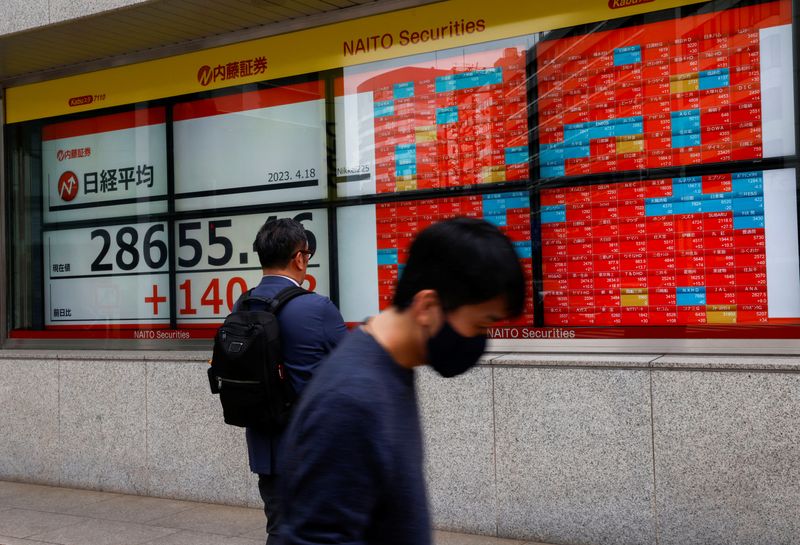
In Asia, MSCI's broadest index of Asia-Pacific shares outside Japan slipped 0.3% and was headed for a monthly loss of 6.3%, the largest since February. Japan's Nikkei, however, gained 1%.
Data on Thursday showed China's manufacturing activity contracted for a fifth straight month in August, but the pace of declines moderated, while the expansion in services sector lost a little momentum.
"The latest official PMI data were not uniformly bad," said Robert Carnell, head of research, Asia-Pacific, at ING.
"Both series (manufacturing and services) seem to be converging on a point close to 50 consistent with an economy that is neither expanding nor contracting. Things could be worse. But markets are not likely to take too much comfort from this set of data."
Chinese blue-chips fell 0.6% while Hong Kong's Hang Seng Index gave up earlier gains to be off 0.5%, weighed by a 1.8% drop in property developers.
Shares in Baidu (NASDAQ:BIDU) and SenseTime gained 3.1% and 2.6%, respectively, as they launched artificial intelligence (AI) chatbots to the public after obtaining government approval.
China's largest private property developer Country Garden warned of default risks if its financial performance continues to deteriorate, fuelling concerns that piecemeal support measures from Chinese authorities are not enough to engineer a turnaround in a critical sector.
Despite the China gloom, the investor mood perked up in August, with a global confidence index (ICI) from State Street (NYSE:STT) Global Markets surging 11.4 points to 107.7, led by North America which recorded the strongest reading in a year on easing recession fears.
Overnight, Wall Street rose after a slew of U.S. economic indicators generally surprised to the downside, adding to bets that the Federal Reserve is done tightening and rate cuts next year could amount to more than 100 basis points.
Private payrolls clocked a 52.3% monthly drop, adding to signs of a softening in the labour market, while second-quarter GDP was revised lower.
Attention now turns to inflation numbers as measured by the U.S. personal consumption expenditures (PCE) on Thursday - the Federal Reserve's preferred gauge of inflation - and non-farm payrolls on Friday.
Action in the Treasuries market was muted after a brutal sell-off earlier this month. Ten-year yields held at 4.1140%, having steadied in the past few sessions. They were nonetheless 16 basis points higher in August.
Two-year yields stood at 4.8899% on Thursday, after briefly dipping to a three-week low of 4.8360% overnight.
There was, however, less cheer in Europe on the inflation front. Annual inflation in Germany and Spain barely slowed in August, against expectations, raising the stakes for the euro zone inflation numbers later in the day.
Bets that the European Central Bank will have to hike in September saw the euro surge on the yen, hitting a 15-year high of 159.76 yen overnight. It last hovered at 159.4 yen on Thursday.
Oil prices were mostly flat. Brent crude futures were little changed at $85.90 per barrel and U.S. West Texas Intermediate crude futures were steady at $81.67.
The gold price was slightly higher at $1,945.49 per ounce.
By Wayne Cole
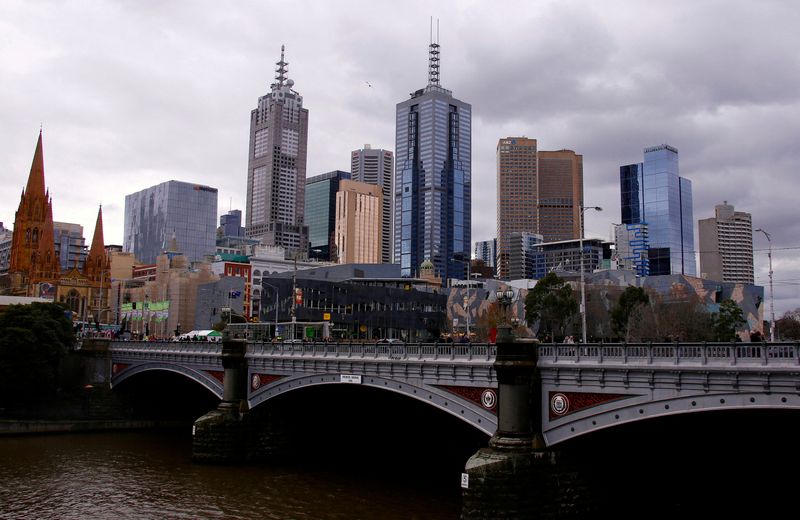
SYDNEY (Reuters) - Australian business investment climbed to its highest since late 2015 in the June quarter as firms took advantage of tax breaks to splurge on new equipment, while plans for future spending were also upgraded in a much-needed boost to the economy.
Data from the Australian Bureau of Statistics on Thursday showed private capital spending climbed a real 2.8% in the second quarter from the previous quarter, handily beating forecasts of a 1.2% increase.
Spending of A$37.58 billion ($24.43 billion) was the highest since late 2015, while investment in equipment reached a record peak of A$17.53 billion.
The construction sector boasted the biggest gains as firms finally received deliveries of machinery and vehicles after lengthy supply-chain delays.
Firms also lifted spending plans for the fiscal year to June 2024 to A$157.8 billion, up 14.5% on the previous quarter.
The strength in investment is a welcome shot in the arm to economic growth given rising interest rates and painfully high inflation has taken a heavy toll on consumer spending.
Figures for gross domestic product (GDP) for the June quarter are due next week and analysts are tipping growth of only around 0.3%. That would see the annual pace slow to just 1.8%, the lowest since early 2021 when the economy was emerging from pandemic lockdowns.
Indeed, an extended period of sub-par growth lies ahead as the Reserve Bank of Australia (RBA) tries to curb inflation with interest rates at decade highs of 4.1%.
Inflation figures for July out on Wednesday suggested the policy was working, albeit gradually, and markets assume rates will again be held steady at the RBA's September policy meeting next week.
Investors also suspect the entire tightening cycle might now be over as futures imply only around a 40% chance of a hike by year end.
Nomura economist Andrew Ticehurst cautioned there was a risk of perhaps one final rate rise in November, though it would be a very close call.
"At the same time, the latest data support our broader views that the economy will skirt with recession and inflation will ease further over coming quarters, and that the RBA could commence a more aggressive easing cycle than is currently priced, next year," he said.
He is tipping three quarter-point cuts in 2024 starting in May, while markets are leaning toward just one easing late in the year.
($1 = 1.5370 Australian dollars)
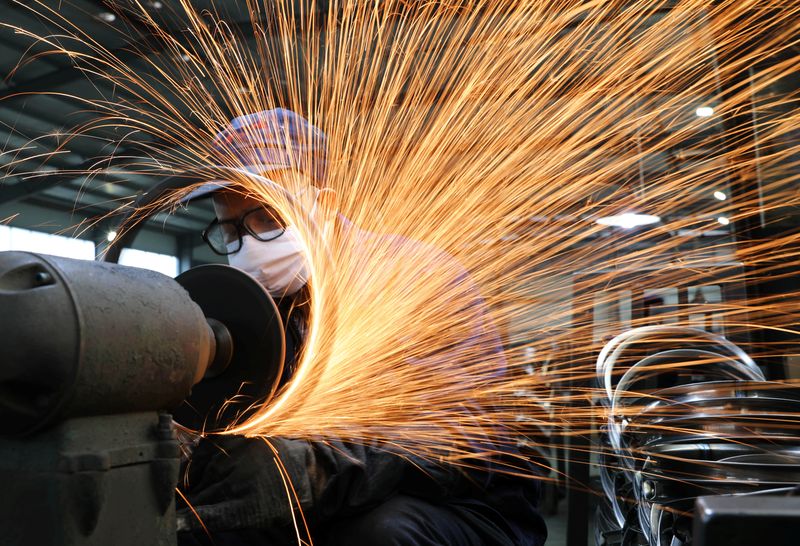
BEIJING (Reuters) -China's manufacturing activity contracted for a fifth straight month in August, but at a slower than expected pace, an official factory survey showed on Thursday, maintaining pressure on Beijing to step up policy support for the stuttering economy.
The official purchasing managers' index (PMI) rose to 49.7 from 49.3 in July, according to the National Bureau of Statistics, staying below the 50-point level demarcating contraction from expansion. The reading was above a forecast of 49.4.
The Chinese economy risks missing Beijing's annual growth target of around 5% as it contends with a worsening property slump, weak consumer spending and tumbling credit growth, leading major banks to downgrade their growth forecasts for the year.
Beijing on Sunday announced halving the stamp duty on stock trades, the first cut to the tax since 2008, to boost investor sentiment.
Detailed rules were also unveiled on Friday to ease first-home mortgages. And some Chinese state-owned banks will soon lower interest rates on existing mortgages.
The fresh moves came after a raft of measures aimed at reviving big-ticket purchases, notably of new-energy vehicles. Still, many analysts see only a slim chance for any drastic stimulus amid concerns over mounting debt risks.
The official non-manufacturing PMI fell to 51.0 from 51.5 in July, while the composite PMI, including both manufacturing and non-manufacturing activity, rose to 52.3 from 51.1.
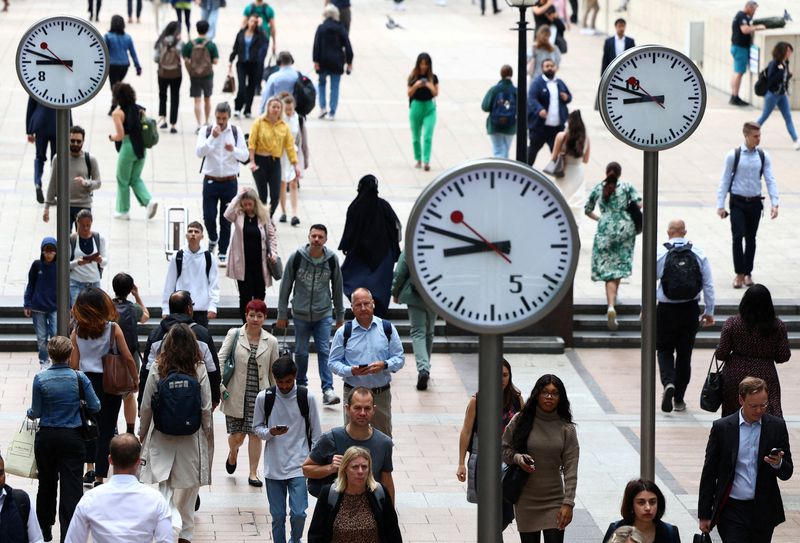
LONDON (Reuters) - British companies are their most confident since before Russia's invasion of Ukraine, according to a survey that also showed they planned to keep on raising prices and staff pay, adding to worries for the Bank of England about high inflation.
Contrasting with signs of an economic slowdown in other recent surveys, the Lloyds (LON:LLOY) Bank Business Barometer measure of confidence jumped by 10 points in August to 41%, its highest since February 2022.
"The bounce in economic optimism this month is the stand-out point," Hann-Ju Ho, senior economist at Lloyds Bank, said.
"Our analysis shows that businesses felt relief that interest rates may be reaching their peak, alongside hopes that measures to tackle inflation are having an impact."
The BoE raised rates for the 14th time in a row this month to counter an inflation rate running at almost 7%. But the quarter-percentage-point increase was smaller than June's 50-basis-point hike.
Investors mostly expect the Bank Rate to peak this year at 5.75%, up from its current level of 5.25%.
Britain has avoided a widely forecast recession so far this year but worries about an economic slowdown grew last week when a measure of business activity in August fell to its lowest since January 2021.
Thursday's survey showed firms' hiring intentions were the strongest in 15 months and the share of businesses planning to increase staff wages was the highest since Lloyds began asking about pay in 2018, with 30% of firms predicting a 3% pay rise.
Other surveys have shown pressure on firms to raise pay by more although human resources data company XpertHR last week reported the first slowdown this year in the pace of wage deals during the three months to July.
A net balance of 56% of firms intended to increase their prices, Lloyds said.
Smaller firms were more upbeat than bigger ones which had more exposure to the global economy and manufacturing firms were more downbeat than other companies, it said.


 한국어
한국어
 Tiếng Việt
 中文
中文